
Here’s something many patients don’t anticipate: port access often gets more painful over time, not less. You might assume that your body would get used to the needle, that repeated access would somehow become easier. For some patients, that’s true. But for many others, the opposite happens—and the reason is scar tissue.
Every time a needle pierces your skin, your body responds by producing collagen fibers to repair the puncture site. Over repeated access sessions—weeks, months, sometimes years of treatment—those collagen fibers accumulate. The skin and tissue above your port becomes thicker, tougher, and less pliable. This is scar tissue, and it’s a natural and unavoidable consequence of repeated needle insertion in the same location.
Scar tissue is denser than normal skin. It has less blood flow and fewer nerve endings in some areas but can also create zones of heightened sensitivity. The result is that the needle has to push through tougher material to reach the port, which often translates to more pain, more pressure, and more difficulty for the nurse performing the access.
Scar tissue doesn’t just make the needle insertion harder—it also makes numbing harder. Topical anesthetics like lidocaine work by penetrating the skin and blocking nerve signals beneath the surface. When the skin above your port is normal, healthy tissue, the cream can penetrate relatively effectively. But scar tissue is thicker and less permeable. The cream takes longer to penetrate, may not reach as deeply, and sometimes doesn’t numb as completely.
This is why patients who’ve had their port for a long time often say something like, “The numbing cream used to work, but now it doesn’t seem to help as much.” The cream may be the same—but the tissue has changed.
When scar tissue is involved, every minute of contact between the numbing cream and the skin matters. The cream needs maximum time at full concentration, sitting directly over the port, without being diluted, displaced, or absorbed by clothing. There’s no room for error.
This is exactly where plastic wrap fails. Even on normal skin, plastic wrap is unreliable. On patients with scar tissue—patients who need their numbing cream to work harder and longer—a method that leaks and shifts is essentially guaranteeing inadequate numbing.
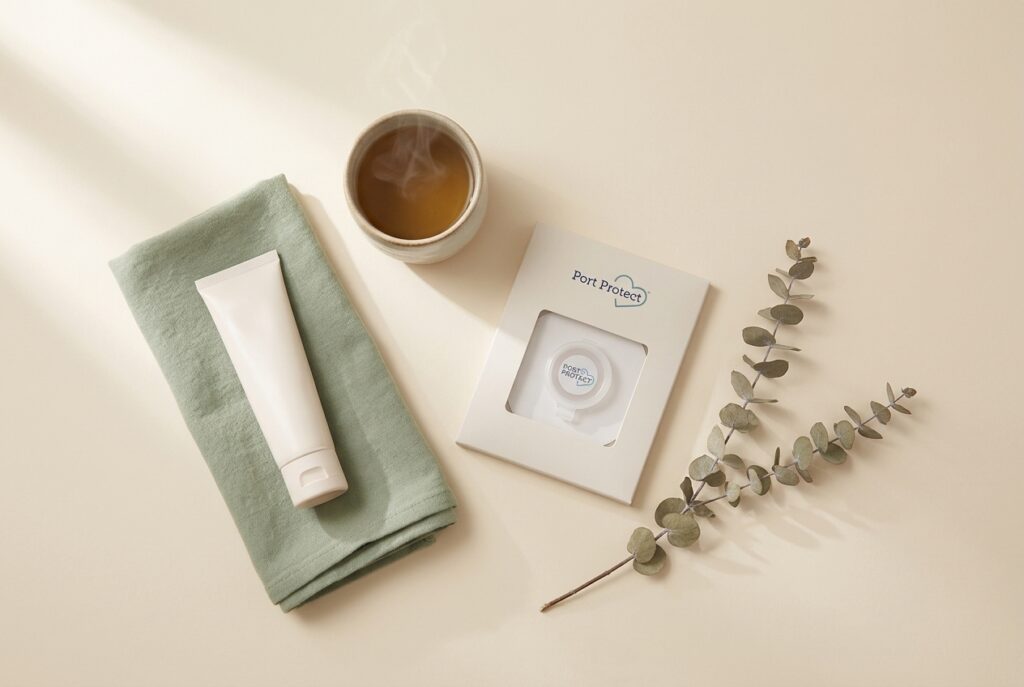
Port Protect was designed to solve this. By creating a sealed reservoir directly over the port site, Port Protect keeps the cream in full contact with the skin for the recommended 30 to 60 minutes. No leaking, no shifting, no wasted cream. For scar tissue patients, this reliable seal can mean the difference between arriving numb and arriving in dread.
Scar tissue is a reality of long-term port use. You can’t avoid it. But you can adapt your preparation to account for it. The patients who manage scar tissue pain most effectively are the ones who take their numbing routine seriously—the right cream, the right amount, the right timing, and a reliable method for keeping it all in place.
Port Protect gives you that reliability. Because when your body is already fighting harder than most, your numbing cream should be working harder too.